
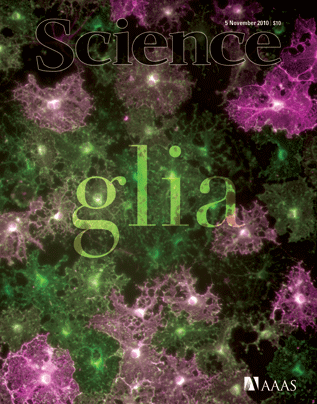
 My “Life Science Technology” feature on flow cytometry appears in the Nov. 5 issue of Science. Focusing on what’s new and different in this decades-old technology, I discovered some really nifty approaches, from a shoebox-sized instrument that travelled to the waters off Antarctica, to an imaging-based cytometer that reports not only protein abundance but also its subcellular location. The technology that most fascinated me, though, was a mass spec-based cytometer called CyTOF, from DVS Sciences.
That’s the way cells flow…
•November 4, 2010 • Comments Off on That’s the way cells flow…Science through the eyepieces
•November 2, 2010 • Comments Off on Science through the eyepieces The November issue of BioTechniques magazine includes my TechNews feature on digital photomicroscopy contests, “Awards Season: Science through the eyepiece.” Taking a look at the people who enter the Nikon Small World and Olympus BioScapes competitions — their methods and motivations — I discovered that some microscopists deliberately seek out images to enter, while others essentially stumble across a winning shot. All are artists, blending visually stunning images with scientific import, and all have interesting stories to tell. But my favorite by far was that of UCSF researcher Matt Springer, whose black-and-white 4th place entry in Nikon’s 2008 competition, dubbed the “Dance of the Dicty,” languished in a drawer for 15 years before Nikon plucked it from obscurity. Springer calls the image, taken during his time as a postdoctoral fellow, “a good conversation starter.” Colleagues who only know of his current research on blood vessels often ask about his former work, having seen it in the ubiquitous calendars Nikon distributes to its customers. “Ironically, because of that calendar, I think more people have seen that photo than any of the ones I [published] for my research project,” he says.
Picking the perfect postdoc
•September 1, 2010 • Comments Off on Picking the perfect postdoc When I applied for my first postdoc, lo these many years ago (13 to be precise), it was all about the science. I was looking for a position with an advisor whose research I found interesting, yet had the name recognition to help me launch an independent research career. Personality issues and benefits were secondary considerations.
Fast-forward to 2010, and now I’m a science writer (lapsed scientist? Or perhaps, recovering scientist?) researching an article about what postdocs should think about before joining up with a new lab. That article was published in the 2 September issue of Nature [URL]. What follows are some bits and bobs from the editing room floor…
Gearing up for ScienceWriters 2010
•August 26, 2010 • Comments Off on Gearing up for ScienceWriters 2010 Great news! My panel on “Profitable Freelancing: Starting a business and keeping it productive,” was accepted for ScienceWriters 2010, Nov. 5-9 at Yale University in New Haven, CT. I’ll be joined on the stage by freelancers Christopher Mims, John Pavlus, and Amber Dance. From the panel description:
Freelance writers wear many hats: Writer and editor; CEO and employee; treasurer and accountant. Your job: Fill each role as efficiently as possible to maximize time in Writer (read: money-making) mode. You’ll need to be productive. There’s no shortage of advice out there, so you’ve got to be selective: Narrow focus on productivity can be, well, counterproductive. This panel will address workable productivity ‘hacks’ freelancers can implement, both online and off, to establish and sustain their freelance business with maximal efficiency and minimal fuss.
This workshop will include both a panel discussion and audience Q&A. An online survey, conducted in advance of the meeting, will inform the conversation, and tips and tricks from both the presenters and the audience will be made available to the community-at-large via a blog specifically set up for this session.
I hope to see you this November in New Haven. In the meantime, follow the panelists at Freelancer Hacks, the blog of “Productivity hacks by hacks, for hacks.”
A matter of laboratory safety
•August 26, 2010 • Comments Off on A matter of laboratory safety The August 2010 issue of Nature Methods includes my Technology Feature on laboratory safety. Dry, you say? Hardly. While it is true that lab safety incidents are increasingly rare across the US (declining from 2.1 incidents per 100 full-time employees in 2003 to 1.2 in 2008, according to US Bureau of Labor Statistics figures), the potential for catastrophic events is ever-present. In 2009 a 23-year-old lab worker at UCLA died of injuries sustained when the highly reactive chemical she was using, t-butyl lithium, ignited. That said, today’s laboratories are safer than ever, a reflection of evolving technologies (eg, next-gen sequencing vs. classical radioactive Sanger sequencing), miniaturization (employing smaller volumes), and automation. That’s not to say lab safety officers can just retire. With new technologies come new concerns, and today’s lab safety officer has to worry about issues like repetitive stress injuries caused by micropipettors and keyboards, novel pathogens in stem cell cultures and flow cytometry labs, and the toxicity of newly minted nanomaterials. Says Jim Turk, assistant director of environment, health and safety at the University of Wisconsin, Madison, “[when] you get a lot of people handling stuff, accidents are going to happen. We tend to err on the side of caution.”
 Biotechnically Speaking