12/12/12: An end-of-the-year update

•December 12, 2012 • Comments Off on 12/12/12: An end-of-the-year update

Well, it’s 12 December 2012, aka 12/12/12 (or, as they say in Europe, 12/12/12), and that means the year is coming to a close. For me, it’s been an annus mirabilis. I’ve been busier than ever, picking up new clients at the Journal of the American Chemical Society and Fierce Biotech. I began blogging, first at the Huffington Post and later, at Double X Science. And I’ve been able to network with my fellow science writers at ScienceOnline 2012, and secured a spot at next years’ gathering too.

I’ve also been able to put together some really fun pieces in the past few months. A few highlights:

Over at BioTechniques, I spoke with the people behind the proteomics papers, the mass spectrometry experts who tailor their instruments to solve otherwise intractable problems (“Pimp my spec!“, PDF). People like Michael Westphall, an astrophysicist-turned-mass spectrometrist, who developed a gas chromatography-coupled Orbitrap mass spec after a short career detour in rocketry, and Phil Compton, a chemist who devised a more efficient instrument architecture for electron transfer dissociation.

Also in Biotechniques, I wrote about new methods for probing the structure of DNA (PDF), techniques like atomic force microscopy and FRET, magnetic tweezers and electron microscopy.

I wrote about the new technologies of epigenomics over at Science, and also at The Scientist, where I focused on data analysis. At Double X Science, I wrote about a potential antibody therapy for hemophilia A and new methods for downsizing x-ray crystallography. And in The Scientist, I penned a short item on the proliferation of new genomics-focused undergraduate courses

It’s been a busy year, and I’m looking forward to an even busier 2013. In the meantime, head over to my Publications page for a complete listing of my work.

A new writing gig, and other news

•September 20, 2012 • Comments Off on A new writing gig, and other news

I can’t believe it’s been nearly a year since I’ve updated this page. Obviously, a lot can happen in that time, so I’ll just hit the high-points.

First off, some exciting news. The brilliant writers over at Double X Science (“Science, I am just that into you”), have given me a platform to talk tech. I’ve written two posts so far, one on a nanotech-based test for MRSA, the other on microbe-made biofuels.  (I also penned a few pieces for the Huffington Post, on 3D imaging of individual nanoparticles and in vitro molecular evolution.)

I’ve been named a contributing writer over at BioTechniques, writing TechNews features for them about once a month. Some of my favorites from the past year have discussed cell motility, single-cell genomics, and top-down proteomics. I also got to write a fun piece on molecular gastronomy, and another on how researchers spend — and don’t spend — their startup funds (Run your lab on dollars a day!).

I wrote about strategies labs can use to get by in tough economic times for NatureJobs, and about animal-free toxicology and protein microarrays for Science.

At The Scientist, I’ve covered about flow cytometry and microbiology lab automation, and penned a fun Notebook item on the technicians who work in Michael Davidson‘s microscopy lab at Florida State University (Microscopy Boot Camp).

There’s more, of course. For a complete list of my clips, click here.

A look back as we fall back…

•November 8, 2011 • 1 Comment

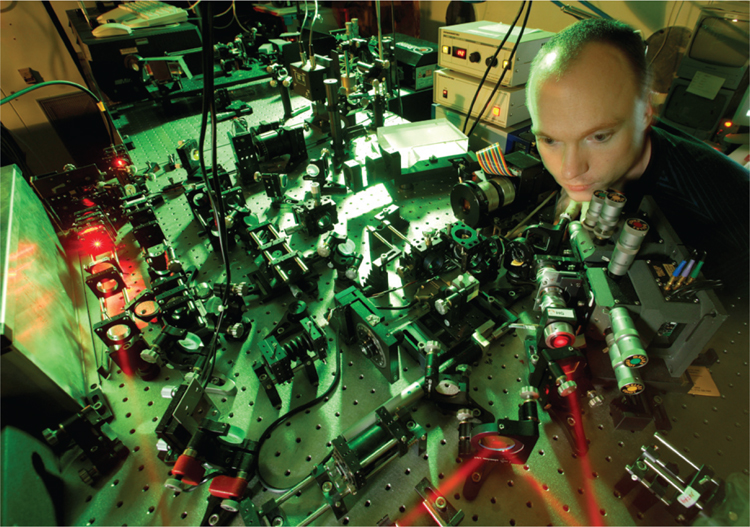
Image: Petra Fromme & Raimund Fromme, ASU/BioTechniques

Hello, and happy Fall! As our internal clocks labor to get back into sync with the annual falling back of our (physical) clocks, I thought I’d update you on some of my newest and most noteworthy articles:

In the online edition of Chemical and Engineering News, I wrote about devices to monitor tissue oxygenation during surgery (Aug. 26) and chemically sniff out sea mines underwater (Oct. 10), as well as a new method to synthesize fluorescent “upconversion nanoparticles” in the microwave (Nov. 3).

In BioTechniques, I wrote about the ongoing problem of cell line misidentification (August) — a problem that could potentially invalidate thousands of studies and millions of dollars worth of research — as well as techniques for monitoring protein conformation in vivo (October) and antibody engineering (November). The latter methods — phage display, yeast display, and related approaches — could ultimately help generate “protein binders” for every protein in the human proteome, an idea that is already moving ahead (viz: this NIH RFA), albeit slowly.

Continue reading ‘A look back as we fall back…’

A long overdue update…

•July 16, 2011 • Comments Off on A long overdue update…

Credit: Biotechniques.com/A. Fromann

It’s been a busy few months of late, and I’ve been remiss in updating you on what I’ve written. So, without further ado, here’s a summary of what’s new:

Enjoy!

Synthetic genomics: Building a better bacterium

•April 8, 2011 • Comments Off on Synthetic genomics: Building a better bacterium

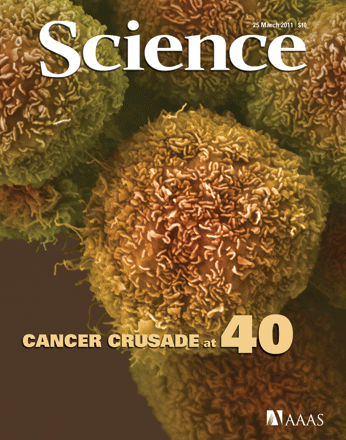
Credit: Science magazine

The March 25 issue of Science magazine includes my latest Life Science Technologies feature, “Synthetic genomics: Building a better bacterium.” Driven by J. Craig Venter’s blockbuster announcement of a “synthetic cell,” this article looks at the technologies and challenges inherent in trying to craft a genome from the ground up.

Continue reading ‘Synthetic genomics: Building a better bacterium’

Making the connections

•February 28, 2011 • Comments Off on Making the connections

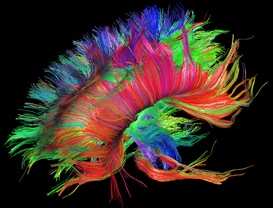
My feature on neural connectivity — known in ‘omics parlance as “connectomics” — appeared this past October in BioScience Technology magazine [5M PDF]. Appearing shortly after the September 2010 launch of the NIH-funded Human Connectome Project, the article looks at the technologies researchers will use to untangle the cerebral spaghetti that is neural connectivity.

It’s a daunting task; by one estimate, “each human brain contains an estimated 100 billion neurons connected through 100 thousand miles of axons and between a hundred trillion to one quadrillion synaptic connections.” Those connections seemingly govern learning, memory, personality, and disease; says MIT computational neuroscientist Sebastian Seung, “I am my connectome.”

Continue reading ‘Making the connections’

Sequencing gets physical

•February 4, 2011 • Comments Off on Sequencing gets physical

The February issue of BioTechniques includes my TechNews feature on non-optical (i.e., physical) DNA sequencing methods, “Making Contact with Sequencing’s Fourth Generation.” Hard on the heels of Life Technologies’ launch of the Ion Torrent Ion PGM sequencer last December, the article takes a look at the technology underlying that device (it’s basically the world’s smallest pH meter), and electron microscopy- and nanopore-based methods as well.

With an instrument cost of just $50,000 (and a per-run cost of about $500) the Ion PGM, says the Broad Institute’s Chad Nusbaum, could “democratize” DNA sequencing, filling a need for those researchers who have neither the need for, nor the access to the gigabase-spewing behemoths currently dominating the next-gen market. Other physical methods, though still in development, could similarly upend the sequencing industry. But don’t count existing technologies out just yet, says Harvard geneticist George Church; Life Technologies, Illumina, 454, and the like still have some juice left in them, too. Church cites five niches that could help a new technology establish a beachhead: cheaper instruments, lower costs per run, longer reads, faster speed, and portability. “But to really capture the market,” he says, “it’s going to be dollars per base pair.”

Glycoproteomics: The sweet smell ofwe’re-getting-there

•January 14, 2011 • Comments Off on Glycoproteomics: The sweet smell ofwe’re-getting-there

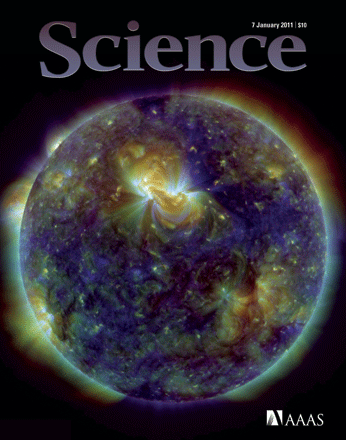
The Jan. 7 issue of
Science magazine includes my latest Life
Science Technologies feature, on glycoproteomics.
Concentrating on the sweet science of mass spectrometry, this
article examines the technical challenges inherent in cataloging
and characterizing all the carbohydrate modifications on all the
proteins in a given cell, tissue, or organism.
Continue reading ‘Glycoproteomics: The sweet smell ofwe’re-getting-there’

Bright lights, single molecules

•December 13, 2010 • Comments Off on Bright lights, single molecules

The December issue of BioTechniques includes my TechNews feature on single-molecule FRET, “Bright lights, single molecules.” A technique for measuring the relative distance and orientation of two molecules relative to one another, smFRET has been likened to a “molecular ruler.” It has been used to study the folding of proteins of RNAs, the assembly of macromolecular complexes, and even drives an in-development “3rd-generation” sequencing technology called Project Starlight (Life Technologies).

Continue reading ‘Bright lights, single molecules’

ScienceWriters 2010 final roundup…

•November 7, 2010 • Comments Off on ScienceWriters 2010 final roundup…


Just a quick note to say ScienceWriters 2010 is done, and I’m heading back home after a lovely weekend in New Haven. I posted a complete roundup of links to our session, including slide decks, blog postings, and video, here. Check it out, and keep the productivity conversation going, on Freelancer Hacks.